
List of words
The vocabulary list for "Personality Traits" with IPA British English transcription and Russian translation.
Personality Traits (A1-A2 Level)
- kind /kaɪnd/ - добрый
- unkind /ʌnˈkaɪnd/ - недобрый
- friendly /ˈfrend.li/ - дружелюбный
- unfriendly /ʌnˈfrend.li/ - недружелюбный
- polite /pəˈlaɪt/ - вежливый
- impolite /ˌɪm.pəˈlaɪt/ - невежливый
- rude /ruːd/ - грубый
- funny /ˈfʌn.i/ - забавный, смешной
- boring /ˈbɔː.rɪŋ/ - скучный
- serious /ˈsɪə.ri.əs/ - серьезный
- honest /ˈɒn.ɪst/ - честный
- dishonest /dɪˈsɒn.ɪst/ - лживый, нечестный
- shy /ʃaɪ/ - застенчивый
- confident /ˈkɒn.fɪ.dənt/ - уверенный
- quiet /ˈkwaɪ.ət/ - тихий
- talkative /ˈtɔː.kə.tɪv/ - разговорчивый
- brave /breɪv/ - храбрый
- cowardly /ˈkaʊ.əd.li/ - трусливый
- helpful /ˈhelp.fəl/ - отзывчивый, полезный
- unhelpful /ʌnˈhelp.fəl/ - неотзывчивый
- selfish /ˈsel.fɪʃ/ - эгоистичный
- smart /smɑːt/ - умный, сообразительный
- foolish /ˈfuː.lɪʃ/ - глупый
- hardworking /ˌhɑːdˈwɜː.kɪŋ/ - трудолюбивый
- lazy /ˈleɪ.zi/ - ленивый
- generous /ˈdʒen.ər.əs/ - щедрый
- selfish /ˈsel.fɪʃ/ - эгоистичный
- clever /ˈklev.ər/ - умный, сообразительный
- stupid /ˈstjuː.pɪd/ - глупый
- creative /kriˈeɪ.tɪv/ - креативный, творческий
- unimaginative /ˌʌn.ɪˈmædʒ.ɪ.nə.tɪv/ - лишенный воображения
- dull /dʌl/ - скучный, неинтересный
- cheerful /ˈtʃɪə.fəl/ - жизнерадостный
- sad /sæd/ - грустный
- confident /ˈkɒn.fɪ.dənt/ - уверенный
- unsure /ʌnˈʃɔːr/ - неуверенный
- respectful /rɪˈspekt.fəl/ - уважительный
Infographic
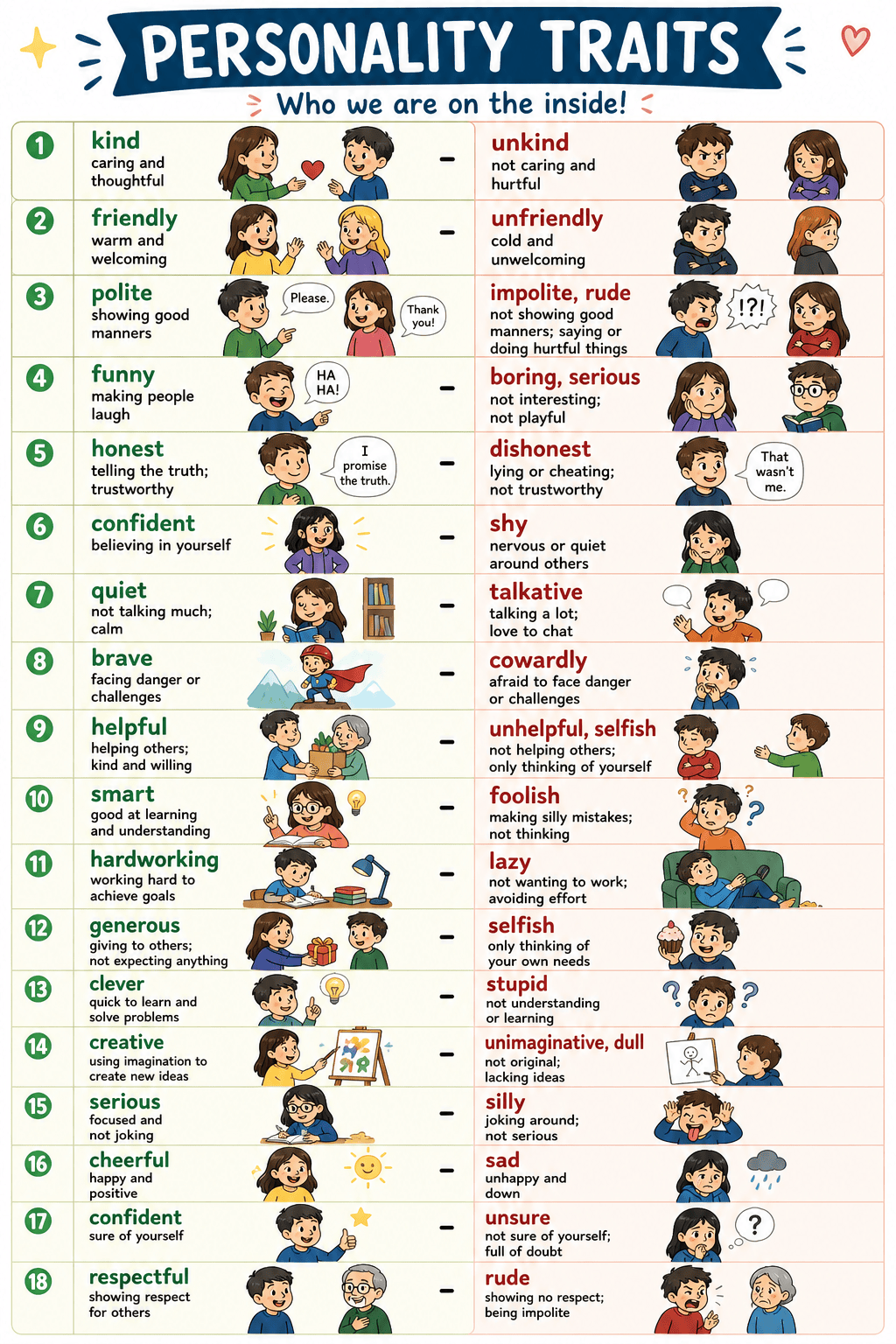
Introducing new words

Click to play
What Are You Like? Talking About Personality
When we describe a person, we can talk about how they look, but it is also important to describe their personality. Personality is what a person is like on the inside. Here are some common words to describe people.
Какой ты? Говорим о характере
Когда мы описываем человека, мы можем говорить о том, как он выглядит, но также важно описать его характер (personality). Характер (personality) — это то, какой человек есть внутри. Вот несколько распространённых слов для описания людей.
Some people are very kind. They are nice to others and they help them. A kind person is not unkind. A friendly person says hello and likes to talk to new people. An unfriendly person does not smile, does not want to talk, and doesn’t like making friends.
Некоторые люди очень добрые (kind). Они хорошо относятся к другим и помогают им. Добрый (kind) человек не является недобрым (unkind). Дружелюбный (friendly) человек здоровается и любит разговаривать с новыми людьми. Недружелюбный (unfriendly) человек не улыбается, не хочет разговаривать и не любит заводить друзей.
It is good to be polite. A polite person says "please" and "thank you." A person who is not polite is impolite or rude. A funny person makes people laugh. A person who is not funny can be boring or very serious.
Хорошо быть вежливым (polite). Вежливый (polite) человек говорит «пожалуйста» и «спасибо». Человек, который не вежлив, — невежливый (impolite) или грубый (rude). Веселый человек заставляет людей смеяться. Человек, который не веселый, может быть скучным (boring) или очень серьёзным (serious).
A good friend is honest. An honest person tells the truth. A person who tells lies is dishonest. A shy person feels a little nervous with new people. A confident person feels sure of themselves and is not shy. A quiet person does not talk a lot. A talkative person talks a lot!
Хороший друг — честный (honest). Честный (honest) человек говорит правду. Человек, который говорит неправду, — нечестный (dishonest). Застенчивый (shy) человек чувствует себя немного нервно с новыми людьми. Уверенный (confident) человек чувствует себя уверенно и не стесняется. Тихий (quiet) человек не говорит много. Разговорчивый (talkative) человек говорит много!
In a difficult situation, it is good to be brave. A brave man does not let fear defeat him. When a person is easily overcome by fear, they say that he is cowardly or a coward. It is nice to be helpful. A helpful person assists others. An unhelpful or selfish person only thinks about themselves.
В сложной ситуации хорошо быть храбрым (brave). Храбрый человек не дает страху победить его. Когда человек легко побеждается страхом говорят что он трусливый (cowardly) или трус (coward). Приятно быть отзывчивым (helpful). Услужливый (helpful) человек помогает другим. Неотзывчивый (unhelpful) или эгоистичный (selfish) человек думает только о себе.
In school or at work, it is good to be smart or clever. A smart person learns new things quickly. The opposite of smart is foolish or stupid. To do well, you need to be hardworking. A hardworking person does their work with energy. A lazy person does not want to work. They prefer to do nothing. A lazy person is the opposite of hardworking.
В школе или на работе хорошо быть умным (smart) или сообразительным (clever). Умный (smart) человек быстро учится новому. Противоположность умному — глупый (foolish) или глупый (stupid). Чтобы преуспевать, нужно быть трудолюбивым (hardworking). Трудолюбивый (hardworking) человек работает с энергией. Ленивый (lazy) человек не хочет работать. Он предпочитает ничего не делать. Ленивый (lazy) человек — это противоположность трудолюбивому (hardworking).
A generous person likes to share with others. A selfish person does not like to share. A creative person has good, new ideas. A person who is not creative, otherwise called unimaginative or boring, it is more difficult for him to come up with something new.
Щедрый (generous) человек любит делиться с другими. Эгоистичный (selfish) человек не любит делиться. Творческий (creative) человек обладает хорошими, новыми идеями. Человеку, не обладающему творческими способностями (not creative), иначе говоря, лишенному воображения (unimaginative) или скучному (dull), сложнее придумать что-то новое.
Some people are very cheerful and happy all the time. Other people are more serious and think a lot. A person who is always happy is not sad. A confident person is sure of themselves. If you are unsure, you do not feel confident. And remember, it is much better to be polite and respectful than to be rude!
Некоторые люди очень жизнерадостные (cheerful) и всё время счастливы. Другие люди более серьёзные (serious) и много думают. Человек, который всегда счастлив, не является грустным (sad). Уверенный (confident) человек уверен в себе. Если вы неуверенны (unsure), вы не чувствуете уверенности. И помните, гораздо лучше быть вежливым (polite) и уважительным (respectful), чем грубым (rude)!
Vocabulary exercises
Match pairs
Translation - Word
Definition - word
Definition - word
Opposites
Recall the words
1
2
3
4
5
6
7
Fill in the blanks
1
2
3
4
5
6
7
8
9
10
Dialogues
Dialogue 1: A New Classmate
Target words: shy, confident, quiet, talkative, friendly, unfriendly, polite, impolite/rude
Characters: Leo & Mia (classmates)
Mia: Do you know the new boy, Sam?
Leo: Yes. He is very shy and quiet. He doesn't talk much.
Mia: I am the opposite. I am confident and talkative.
Leo: Is he friendly?
Mia: Yes, he smiles a lot. He is not unfriendly at all.
Leo: Is he polite?
Mia: Very polite! He says "thank you" always. He is never impolite or rude.
Leo: That's good. Maybe he will open up soon.
Диалог 1: Новый одноклассник
Миа: Ты знаешь нового мальчика, Сэма?
Лео: Да. Он очень застенчивый (shy) и тихий (quiet). Он мало говорит.
Миа: Я противоположность. Я уверенная (confident) и разговорчивая (talkative).
Лео: Он дружелюбный (friendly)?
Миа: Да, он много улыбается. Он совсем не недружелюбный (unfriendly).
Лео: Он вежливый (polite)?
Миа: Очень вежливый (polite)! Он всегда говорит «спасибо». Он никогда не бывает невежливым (impolite) или грубым (rude).
Лео: Это хорошо. Возможно, он скоро раскроется.
Dialogue 2: Group Project Problems
Target words: helpful, unhelpful/selfish, hardworking, lazy, honest, dishonest, kind, unkind
Characters: Emma & Jake (students working on a project)
Emma: I don't like working with Tom. He is so lazy.
Jake: Really? I thought he was hardworking.
Emma: No. He never does his part. He is very unhelpful and selfish.
Jake: That's not kind.
Emma: I try to be kind, but it's hard. Yesterday he was unkind to Lisa.
Jake: Is he honest at least?
Emma: No, he lies about his work. He is dishonest.
Jake: Let's talk to the teacher. We need helpful people in our group.
Диалог 2: Проблемы с групповым проектом
Эмма: Мне не нравится работать с Томом. Он такой ленивый (lazy).
Джейк: Правда? А я думал, он трудолюбивый (hardworking).
Эмма: Нет. Он никогда не делает свою часть. Он очень бесполезный (unhelpful) и эгоистичный (selfish).
Джейк: Это не добрый (kind) поступок.
Эмма: Я стараюсь быть доброй (kind), но это трудно. Вчера он был недобрым (unkind) с Лизой.
Джейк: Он хотя бы честный (honest)?
Эмма: Нет, он врёт о своей работе. Он нечестный (dishonest).
Джейк: Давай поговорим с учителем. Нам нужны полезные (helpful) люди в нашей группе.
Dialogue 3: Two Brothers
Target words: brave, cowardly, funny, boring/serious, cheerful, sad, generous, selfish
Characters: Mom & her son Alex
Alex: Mom, my brother Ben is so funny. He always makes me laugh.
Mom: Yes, Ben is very cheerful. But your other brother, Mark, is more serious and sometimes boring.
Alex: Mark is never silly like Ben. He is very brave too. He helped a lost dog yesterday.
Mom: Ben can be a little cowardly sometimes. He is afraid of the dark.
Alex: Ben is also generous. He shares his toys. Mark is more selfish – he never shares.
Mom: Every person is different. I love both of them.
Alex: I know. But Ben makes me feel happy, not sad.
Диалог 3: Два брата
Алекс: Мам, мой брат Бен такой смешной (funny). Он всегда заставляет меня смеяться.
Мама: Да, Бен очень жизнерадостный (cheerful). А вот твой другой брат, Марк, более серьёзный (serious) и иногда скучный (boring).
Алекс: Марк никогда не бывает глупым (silly) как Бен. Он ещё очень храбрый (brave). Вчера он помог потерявшейся собаке.
Мама: Бен иногда бывает немного трусливым (cowardly). Он боится темноты.
Алекс: Бен также щедрый (generous). Он делится своими игрушками. Марк более эгоистичный (selfish) – он никогда не делится.
Мама: Каждый человек разный. Я люблю их обоих.
Алекс: Я знаю. Но Бен делает меня счастливым (cheerful), а не грустным (sad).
Dialogue 4: Who Is Smarter?
Target words: smart, foolish, clever, stupid, creative, unimaginative/dull, confident, unsure, rude, polite/respectful
Characters: Teacher Mrs. Jones & two students – Amy and Dan
Mrs. Jones: Amy, you are very smart and clever. Your ideas are always creative.
Amy: Thank you. I like to think differently.
Mrs. Jones: Dan, you are sometimes foolish. You make silly mistakes.
Dan: I'm sorry. I feel unsure about my answers.
Mrs. Jones: You need to be more confident. But please don't be rude in class.
Dan: I try to be polite and respectful. I am not stupid, I promise.
Mrs. Jones: I know. Your work is not dull or unimaginative. You just need to focus.
Amy: Dan, you can ask me for help.
Dan: Thanks, Amy. You are very kind.
Диалог 4: Кто умнее?
Миссис Джонс: Эми, ты очень умная (smart) и сообразительная (clever). Твои идеи всегда креативные (creative).
Эми: Спасибо. Мне нравится мыслить нестандартно.
Миссис Джонс: Дэн, ты иногда бываешь неразумным (foolish). Ты делаешь глупые ошибки.
Дэн: Извините. Я чувствую себя неуверенно (unsure) в своих ответах.
Миссис Джонс: Тебе нужно быть более уверенным (confident). Но, пожалуйста, не будь грубым (rude) на уроке.
Дэн: Я стараюсь быть вежливым (polite) и уважительным (respectful). Я не тупой (stupid), я обещаю.
Миссис Джонс: Я знаю. Твои работы не скучные (dull) и не неоригинальные (unimaginative). Тебе просто нужно сосредоточиться.
Эми: Дэн, ты можешь попросить у меня помощи.
Дэн: Спасибо, Эми. Ты очень добрая (kind).
Additional Exercises
Dialogues
Collocations
Sentence Patterns
What is he/she/it like?
"What is he/she/it like?" - “Какой он/она/оно?" вопрос, используемый для того, чтобы спросить о характере, личности или качествах человека, животного или предмета.
- What is he like? - He is kind and funny.)
- What is she like? - She is hardworking and polite.
ПРИМЕЧАНИЕ: Не путайте вопрос "What is he/she/it like?" с вопросом "What does he/she/it like?", который спрашивает о предпочтениях или интересах.
What is he/she/it like? is a question pattern used to ask about the character, personality, or qualities of a person, animal, or thing.
We use it to ask about personality or character traits:
- What is he like? (Answer: He is kind and funny.)
- What is she like? (Answer: She is hardworking and polite.)
NOTE: This pattern is different from What does he/she/it like?, which asks about preferences or interests.
Other sentence patterns
- He/She is... - He is kind and funny. She is shy and quiet.
- He/She has... - He has a good sense of humor. She has a cheerful personality.
- He/She seems... - He seems very friendly. She seems a bit serious.
- He/She looks... - He looks happy today. She looks confident at work.
- He/She always... - He always helps his friends. She always says polite things.
- What kind of person is he/she? - He is hardworking.
- Do you think he/she is...? - Do you think he is rude? Do you think she is honest?
- He/She can be... - He can be a bit lazy sometimes. She can be very generous with her time.
Speaking and Writing
Writing
Write answers to the questions.
- Are you hardworking or a bit lazy? Explain why.
- Are you a quiet person, or do you like to talk a lot?
- What are you like? Can you describe your personality?
- What is your best friend like?
- Is your friend creative? Can you give an example?
- Do you think you’re more polite or sometimes a bit rude? Why?
- Are you a brave person? When was the last time you did something brave?
Answer the questions
Example: Yes, I find it easy to be friendly to strangers because I like meeting new people and learning about them. It makes me feel good to be kind.
Example: I try to be an honest person because I believe it’s important to tell the truth. Honesty helps build trust with others.
Example: I think it’s better to be funny because it makes people happy and creates a positive atmosphere. But being serious is also important at times.
Example: Yes, people often say I am kind because I like helping others and always try to be polite and understanding.
Example: Not really, I feel nervous when speaking in public. But I’m trying to improve by practicing more.
Describe a person
Describe someone you know (your best friend, brother, sister, parents etc). Use these sentence patterns:
- He/She is... - Example: My best friend is kind and funny.
- He/She has... - Example: My mother has a cheerful personality.
- He/She seems...
- He/She looks...
- What kind of person is he/she?
- Do you think he/she is...?
- He/She can be...
